
Automated Depalletizer: Fully Automated Can Infeed
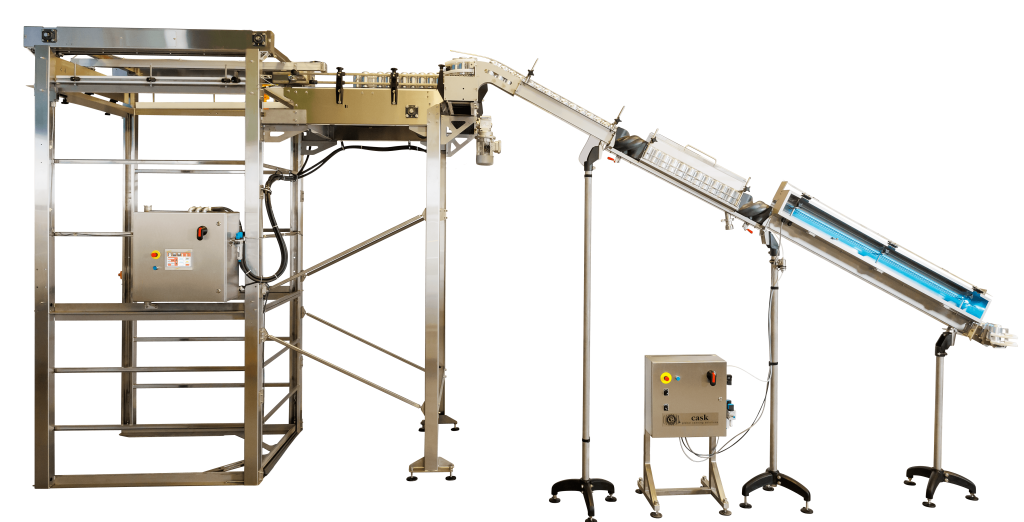
The Automated Depalletizer loads cans straight from the pallet into your canning line. Built on a robust stainless steel frame, it holds a full pallet of accumulation making single-operator packaging realistic. It pairs with the Quick Change Rinser for tool-less can-size changeover in minutes, and optional ionized air and UV-C treatment removes water from the pre-rinse entirely. Setup, height sensing and sweep force are all adjusted on the touchscreen HMI, so the depalletizer adapts to nearly any can size and pallet configuration without tools.
Talk To Cask
Talk to our team for expertise on your right-fit solutions and facility needs.

See the Automated Depalletizer in Operation
This walkthrough shows the Automated Depalletizer running in a co-packer facility, including the full infeed solution from pallet loading to date coding in an operation that has no margin for downtime.
What you will see
- Automated Depalletizer. Cans loaded straight from the pallet to the line, with a force-sensing linear-drive sweeper arm clearing each layer — no pneumatics, and no operator hand-loading cans.
- Ionized Air and UV-C Treatment. Cans treated without water, eliminating rinse water from the process while minimising dissolved oxygen pickup ahead of the fill.
- Quick Change Rinser. Tool-less can changeover — swapping an inverter set for a different can size takes seconds rather than a scheduled changeover.
- Accumulation Conveyance. A full row of cans held as a buffer, so the filler keeps running while the depalletizer changes pallet layers.
- Extended Spill Plate. A wider transfer area from pallet to depalletizer, carrying multiple rows of cans at once for a more stable transfer.
- Delrin Transfer Rails. Low-friction, precision-fit guide rails that move cans smoothly through the transfer and make setup and changeover straightforward.
- Date Coder. Batch codes applied in line for traceability, mounted offset from the main conveyor run.
Automated Depalletizer Specifications
| Specification | Cask Automated Depalletizer |
|---|---|
| Function | Fully automated can infeed, loading cans from the pallet directly to your canning system |
| Accumulation | Full can pallet accumulation, enabling the infeed to run unattended |
| Operators required | Enables 1 primary operator packaging when paired with outfeed automation |
| Configurations | Full-Height, Half-Height and Mobile Half-Height |
| Frame | Full stainless steel with no powder coating; purpose-built for an improved centre of gravity |
| Frame design | Split, collapsible frame for cost-effective shipping and simplified installation |
| Carriage profile | Low carriage profile — sits flat on the ground and loads with a low-profile pallet jack |
| Sweeper arm | Force-sensing, linear-drive sweeper arm with no pneumatics. Frequency and force are customisable for sweeping precision. |
| Lift cables | Industrial-grade 1,500 lb rated cables with turnbuckles and torque-limiting software |
| Outfeed | Wide outfeed spill plate with Delrin rails to minimise cans tipping and sticking |
| Vibration & noise | Redesigned conveyor transfer and adjustable vibrator significantly reduce noise |
| Controls | 7" touchscreen HMI with teachable end positions and programmable force parameters |
| Setup routines | Automated sub-routines assist initial setup, including tier sheet removal and height-sensor adjustment |
| Can size changeover | Quick, tool-less changeover using the Quick Change Rinser |
| Supported can formats | Compatible with nearly all can sizes |
| Supported pallet sizes | Compatible with nearly all pallet dimensions |
| Optional rinse treatment | UV-C and ionized air treatment, eliminating water use and minimising dissolved oxygen pickup during rinsing |
| Compatible systems | Cask Nano ACS, Micro ACS, ACS Mobile, ACS V6 and ACS FleX2. Can also be paired with canning systems from other manufacturers |
| Throughput | Keeps pace with all Cask systems. For ACS FleX2 systems, include Accumulation Conveyance |
| Power | 220VAC, 50/60 Hz, 15 amps, Single Phase |
| Compressed air | Less then 1 cfm (28L/min) at 60psi (4 bar) and minimum 3/8” (10mm) hose connecting compressor to Depal/canning system |
| Installation & training | Training and commissioning is included with a canning system purchase |
Automated Depalletizer FAQs
What does the Automated Depalletizer do?
The Automated Depalletizer loads empty cans straight from the pallet into your canning line. It lifts each layer, sweeps it onto the conveyance, and feeds cans continuously to the filler, so nobody hand-loads cans and the filler never runs dry. It holds full can pallet accumulation, which means the infeed keeps running while your operator works the rest of the line.
Can a depalletizer let me run my canning line with one operator?
Yes — this is the single biggest reason producers buy one. Hand-loading cans is usually the job that pins a second person to the front of the line all shift. Pairing the Automated Depalletizer with outfeed automation such as a Rotary Collection Table or an in-line PakTech applicator enables 1 primary operator packaging on Cask systems. For most producers the labor saved is what pays for the machine.
Will the Automated Depalletizer work with my existing canning line?
Yes. The Automated Depalletizer is system agnostic and can be paired with canning systems from other manufacturers, not only Cask equipment. If you already run a filler you are happy with and the bottleneck is can infeed, you can automate the infeed without replacing the line. Talk to the Cask team about your existing conveyance and transfer height so the integration is engineered to fit.
How much does the Automated Depalletizer cost?
Pricing starts at $41,000 USD and depends on configuration, height option and add-ons such as UV-C and ionized air treatment or accumulation conveyance. Talk with the Cask team for a right-fit quote, and check out Cask's lease calculator tool to explore monthly payment options.
What power and compressed air does the Automated Depalletizer require?
220VAC, 50/60 Hz, 15 amps, single phase — no three-phase service required, which matters because many depalletizers in this class specify three-phase and a producer without it faces an electrical upgrade before commissioning. Compressed air demand is under 1 cfm (28 L/min) at 60 psi (4 bar), through a minimum 3/8" (10 mm) hose. That is a fraction of what comparable machines draw, because the sweeper arm is force-sensing linear drive rather than pneumatic. In practice, most producers can add the depalletizer without upsizing their compressor.
Why is the frame stainless steel rather than carbon steel?
The Automated Depalletizer is full stainless steel with no powder coating. Powder-coated carbon steel chips and corrodes where cans and pallets make contact, and once the coating is broken it cannot be restored in place. Stainless holds up to washdown, spills and humid packaging halls over the life of the machine. The frame is also purpose-built for an improved centre of gravity rather than adapted from a general-purpose design.
How does the sweeper arm avoid tipping or damaging cans?
The sweeper arm is force-sensing and driven by a linear drive, with customisable frequency and force so the sweep can be tuned to your can and layer configuration rather than run at one fixed setting. On the discharge side, a wide outfeed spill plate with low-friction Delrin rails supports the cans through the transfer, minimising tipping and sticking. An extended spill plate option widens the transfer area further to carry multiple rows of cans at once for added stability.
How much floor space and ceiling height does it need?
Ceiling height is usually the deciding constraint rather than floor space, which is why the Automated Depalletizer is available in Full-Height, Half-Height and Mobile Half-Height configurations. The Half-Height options suit packaging halls, basements and taproom spaces where a full-height depalletizer will not clear. The low carriage profile also means the machine sits flat on the ground and loads with a low-profile pallet jack, so no pit, ramp or raised platform is required. Talk to the Cask team with your ceiling height and we will confirm which configuration fits.
Does it keep up with my filler?
The Automated Depalletizer keeps pace with every Cask canning system. On ACS FleX2 lines running at 100 cans per minute, include Accumulation Conveyance, which holds a full row of cans as a buffer so the filler keeps running while the depalletizer changes pallet layers.
How long does it take to change between can sizes?
Changeover is quick and tool-less using the Quick Change Rinser, so swapping to a different can size takes seconds rather than a scheduled changeover with hand tools. The depalletizer is compatible with nearly all can sizes and nearly all pallet dimensions, which is what makes it practical for contract packagers and multi-SKU producers running several formats in a day.
What are the UV-C and ionized air treatment options?
UV-C and ionized air treatment replaces the water rinse entirely. Cans are treated without water, which removes rinse water and its disposal from the process and minimises dissolved oxygen pickup ahead of the fill. It is an add-on rather than standard, and it is worth considering if you are water-constrained, running sensitive products where DO matters, or want to avoid wet cans entering the filler.
How is it controlled, and how hard is it to set up?
A 7" touchscreen HMI gives the operator direct control, with teachable end positions and programmable force parameters — so the machine is taught your configuration rather than dialled in by trial and error. Automated sub-routines assist initial setup, including tier sheet removal and height-sensor adjustment. The intent is that an operator, not an engineer, can set it up and adjust it.
Is it noisy?
Less than you would expect. A redesigned conveyor transfer and an adjustable vibrator significantly reduce noise compared with earlier designs. This matters more than it sounds: depalletizers frequently sit in or beside taprooms and shared production spaces, and can noise carries.
How does it ship and install?
The frame is split and collapsible, which makes shipping materially cheaper and installation simpler than a machine that arrives fully assembled. Industrial-grade 1,500 lb rated lift cables with turnbuckles and torque-limiting software handle the lifting. Combined with the low carriage profile, most sites need no structural preparation.
What do installation and training look like?
Training and commissioning are included in the cost when the Automated Depalletizer is purchased with a Cask canning system. Purchased on its own, it requires 1 day of commissioning and training, which is still hands-on and product focused — concentrating on smooth transitions through the line and on can size changeovers, so your operators can run and reconfigure the machine themselves.
What else pairs with the Automated Depalletizer?
Accumulation Conveyance for continuous supply through pallet layer changes, the Quick Change Rinser for tool-less can size changeover, extended spill plate and Delrin transfer rails for stable can handling, and UV-C and ionized air treatment to remove water from the rinse. Downstream, a Domino Ax130i date coder handles batch coding and traceability, and a Pack Leader PL-501 applies pressure-sensitive wrap-around labels. Explore auxiliary equipment.
Does Cask supply and support equipment in my region?
Yes. Cask supplies and supports canning equipment internationally, with systems running in 80+ countries and 1,800+ active customers. Cask has dedicated regional teams for North America and the UK & Europe. Installation, operator training, spare parts and ongoing support are provided on-site and/or remotely directly through Cask wherever you operate.
What ongoing support does Cask provide after installation?
Cask supports customers for the lifetime of their equipment — with many customers running systems for 20+ years. We support customers directly in over 80 countries, and when you call Cask you get a real human on the phone because packaging doesn't wait for ticket queues. Whether you need a quick question answered, live video troubleshooting during a run, overnight parts or an on-site technician, Cask stands behind its equipment. The goal isn't just to fix issues — it's to help you get the most value out of your system over its entire lifetime.